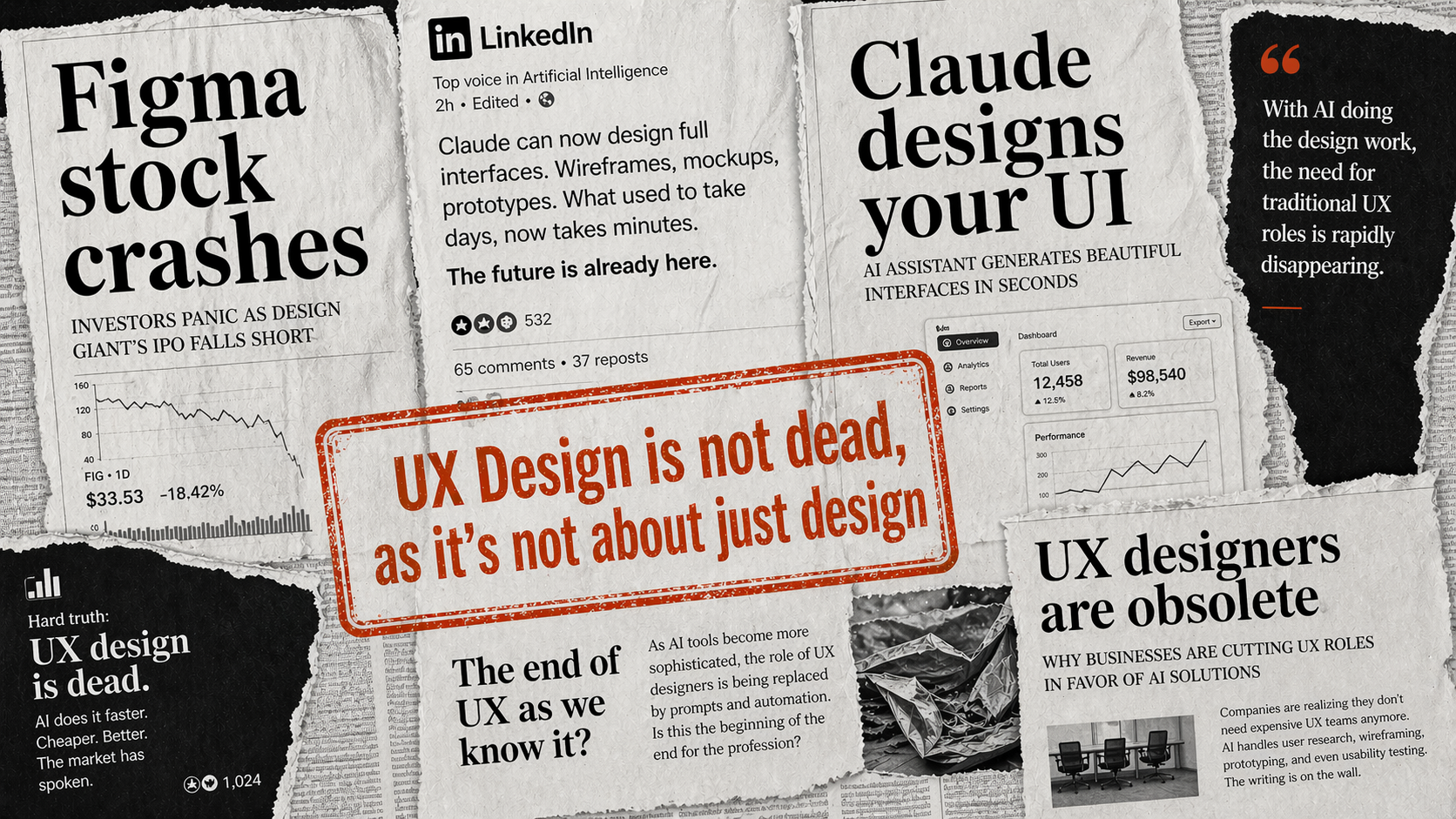
Everyone says Claude Design is replacing UX designers, that Figma is losing its value and that UX design is dead–and I disagree.
As long as there is an Us, there will be an eXperience to build. Whether interactions are between humans, humans and machines or between machines, they are here to stay and so are the people building them. Figma Make, Google Stitch and Claude Design have changed the game and made UX more accessible and faster for anyone wanting to design and developing prototypes, design systems, decks, websites and apps. With only a few clicks, templates and words everyone can build entire user experience flows and design systems. It is the design magic wand. As many other disciplines being threatened by disruption in the past, UX has to reinvent itself and may consider taking up another name.
Product Discovery and Business Understanding–a human tasks
All UX should start with discovery and understanding–and this is something we are as of yet, still better than any AI tool. Since the beginning of time, humans have been asking questions and questioning everything. Our critical thinking and ability to question what we see and hear is a skill no AI tool can master, yet. Neither ChatGPT, nor Claude have ever written back to me: “Lynn, are you sure this is the right problem to focus on and the correct approach?”
Why would they ask such a thing? They often lack the context and bigger picture of my business problem, which I quickly and out of convenience throw at them. Although they have started asking “clarifying questions” with the purpose to gather more information in order to better answer your request, they will probably never have the same subconscious knowledge and deep understanding as well as expertise that you have.
We are still better at talking to users, stakeholder and customers to identify the right problems, setting them into the business context to achieve maximal value for an organisation and for the end-user. Ensuring that the right needs and problems are tackled by the teams is the most critical step before prompting into your Claude Design.
Exploration and Versions-where AI shines
What this disruption is bringing is that with a few words, fast prototypes and various ideas can be built and tested instantly. Still there are some things that everyone should do before entering your prompts and waving the magic wand. When designing new experiences, keep this in mind:
You first, AI second
First always start with your own design, with pen and paper, with your intuition, knowledge and biases at hand. The approach of “I dump everything I have in my mind into the chat and see what pops out” will rarely satisfy you, because you already have an idea in your mind. Starting with AI will lead you down a lane that narrows your point of view and might place focus on the wrong thing. Trust your experience and expertise, design first and upload your sketches with the prompts.
Use AI to remove your bias blindness
We all carry biases and prejudices in our subconscious and can’t shake them off. Maybe we consider ourselves being the user we design solutions for, or our knowledge about customer behaviours or design standards influences our decision making. When finding new solutions to business problems, AI might provide you with new perspectives and ideas that you have not considered yet because of your bias blindness.
Use AI for alternatives, variations and additions
AI is great at developing alternative scenarios, building variations of your solutions or adding things to fully execute on an experience. While it may be a quick way to answer all our “what if questions”, make sure you don’t loose focus for whom you are trying to solve a problem. Just because the AI will draw a house with a white fence and dog house, doesn’t mean you own a dog. Always question if the AI suggestions make sense for your audience and business goal.
Lastly, the entering of agentic design tool that disrupt the UX space should be seen as an opportunity. As more and more non-designer test and use vibe coding tools such as Claude Design, an increase in UX maturity, user expectation and experience quality will be observed. So, although we might have more “designers” out there creating digital experiences, let’s not forget, it is not all about design.
*Image generated by ChatGPT, prompt by Claude.
No Comments.